How it works
Four steps. Any of them can be the last.
It starts with the Exit Interview — a $0, roughly twelve-minute conversation about your stack. Everything after it is priced before you say yes, and every step ends in a document you keep.
One thing you won’t find below is a timeline: we don’t advertise durations we haven’t yet earned — the Audit fixes the build’s price and its date in writing, per engagement.
The Exit Interview — every tool priced, $0
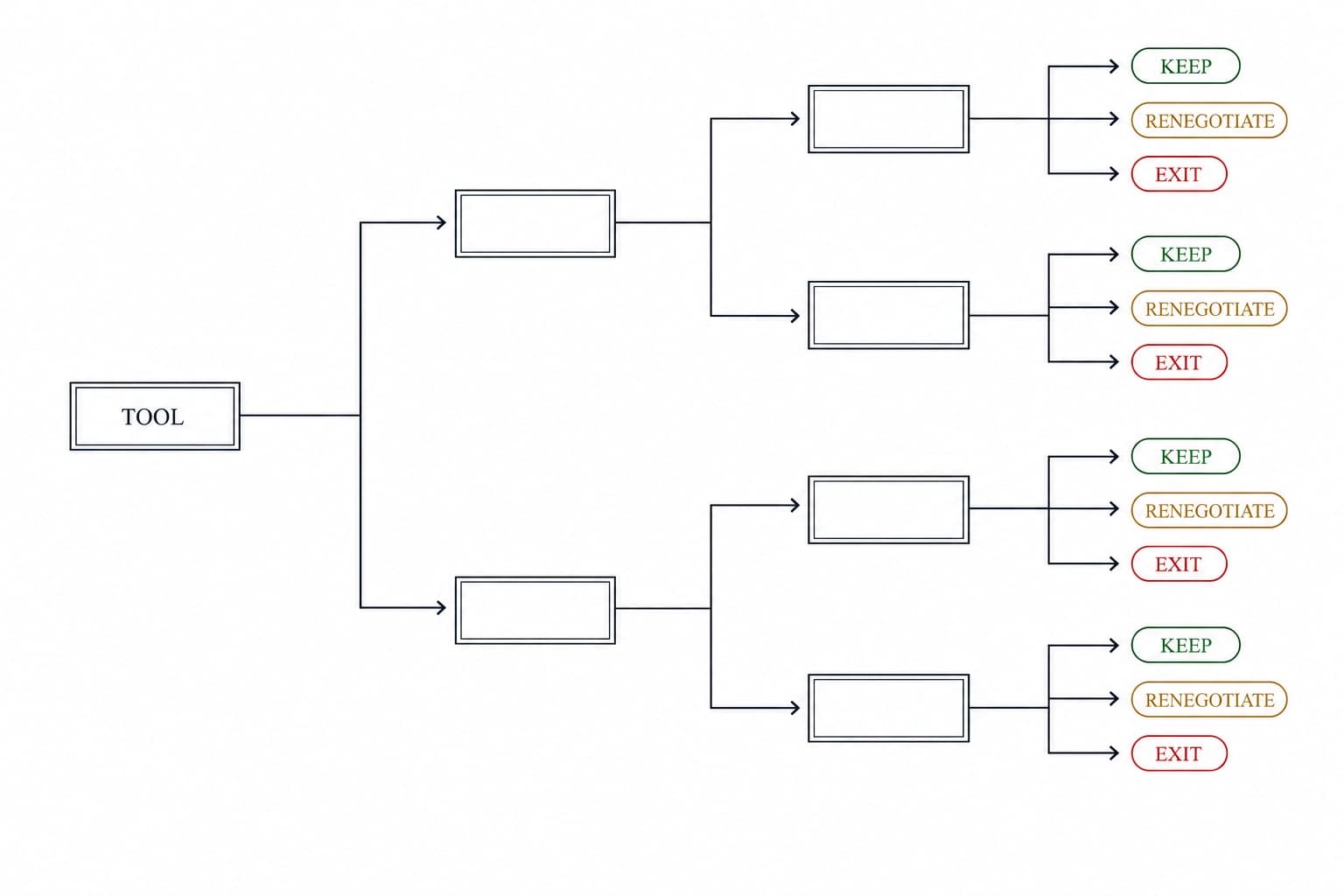
About twelve minutes of questions, self-serve, no sales call. You leave with the Exit Brief: each tool priced per year at list (your own figures win where you have them), the lock-in described in plain words, and a call on every tool — keep it, renegotiate it, or exit — with the reasoning attached. The Brief stops short of a savings number: that takes usage data twelve minutes can't collect, and producing it is the paid Audit's job.
What you supply: Answers about your stack and a work email — nothing else.
The Exit Audit — a paid study that can end in 'keep'
The Interview prices your stack; the Audit studies it. Working from your invoices and usage, it costs $2,500 to $12,000 depending on scope — fixed, and never credited toward a build, so we lose nothing by telling you a tool is worth keeping. It ends with a sequenced exit roadmap and a fixed price for anything worth building.
What you supply: Invoices and usage exports where you choose to share them; list prices stand in where you don't.
Replace & Own — a rebuild that is yours outright
The tools worth replacing come back as AI-first software your company owns: code in your repository from the first commit, IP transferred on payment, and milestone payments as it ships. We start with contained, low-integration tools — a support desk, a work tracker — not your system of record.
What you supply: A repository we can commit to, and someone who can approve milestones.
Run & Govern — what you own stays standing
Ownership comes with upkeep, and we don't hand it to you and leave. Run & Govern keeps what we build patched, monitored, and compliant, with every agent action logged and a named human accountable for the gates that matter.
What you supply: Access to what we built, and who to call.
Agents do the research; a named human signs the judgment
This is an AI-first firm, and it works like one: agents do the research and the drafting, drawing on a registry of per-tool exit playbooks that deepens with every engagement. The judgment never leaves human hands — a named senior specialist signs every engagement, and you know who it is before anything starts. Who signs, and who works alongside them — on the about page.
The work arrives as artifacts, not meetings
No offices, no meetings you have to attend. Work arrives as things you can inspect: committed code, passing tests, a staging environment you can click through, and a written record of the decisions as they are made.
How you leave us
A firm in the exit business should be easy to leave, so the engagement is built that way. The code lives in your repository from the first commit — walking away never requires our cooperation. The IP transfers on payment. The documentation and the per-tool exit playbook are deliverables you keep. And your data moves through your own vendor-official exports, so it never lives only with us.
Leaving us takes no exit project. That is the point of the design.
Every price is public, on one page.
Common questions
- How do we get off per-seat SaaS?
- Start with the facts, not the ideology. The Exit Interview prices every tool from cited list prices, describes the lock-in in plain words, and ends in a keep / renegotiate / exit call on each. The paid Exit Audit turns those calls into a sequenced roadmap with fixed prices, and Replace & Own rebuilds only the tools worth owning.
- What does an Exit Audit cost?
- Three fixed prices, published before you talk to anyone: $2,500 for a single tool, $6,000 for a multi-tool cluster, $12,000 for the full stack. The fee is never credited toward a build, so 'keep this tool' stays an available answer.
- Do we own what you build?
- Outright. The code lives in your repository from the first commit, and the IP transfers on payment. Data migrates through your own vendor-official exports, so the exit never violates the terms you signed.
- Can you get us off Salesforce?
- Usually not first, and we say so. Systems of record carry real lock-in — custom objects, integrations, years of history — so the first fight is usually the renewal, not the exit. We start with contained, low-integration tools; the Audit says which, tool by tool.
- Why not just decide this in-house?
- You can gather the facts in-house, and the Brief helps either way. The verdict is the hard part: the meeting that decides usually includes the people who chose the tools, and it rarely ends in a written call anyone can check later. What we sell is a judgment with no stake in the outcome — the Audit fee is the same whether the answer is keep, renegotiate, or exit — and reasoning on paper you can argue with.
- Who actually does the work?
- Agents do most of it: the research, the drafting, and the per-tool exit playbooks they draw on. The judgment is human — a named senior specialist signs every engagement and stays accountable for it, with specialists engaged per exit across ServiceNow, Microsoft Azure & M365, and Power BI. That roster is still forming, and the about page says exactly where it stands.
The fastest way to rule us out is the Brief itself: twelve minutes, $0, and a verdict on every tool. If it says your stack is worth keeping as it stands, you’re done with us — and the question is settled.