Perspectives · 2026-07-20 · 8 min
Buying software is a decision again
Is buying SaaS still the default for enterprise software?
For twenty years, buy was the default and build was the deviation that had to justify itself. That default is dissolving: the market repriced per-seat software by roughly $285 billion in two days in February 2026, Starbucks has announced it is building replacements for two of its vendor systems, and in Retool's 2026 survey 35% of enterprises said they had already replaced at least one SaaS tool with a custom build. The practical consequence is not 'build everything' — it is that every renewal now silently reopens build-vs-buy, and most organizations have procurement muscle but no apparatus for deciding that question. An audit whose fee is never credited toward a build — so 'keep' stays a real answer — is that apparatus.
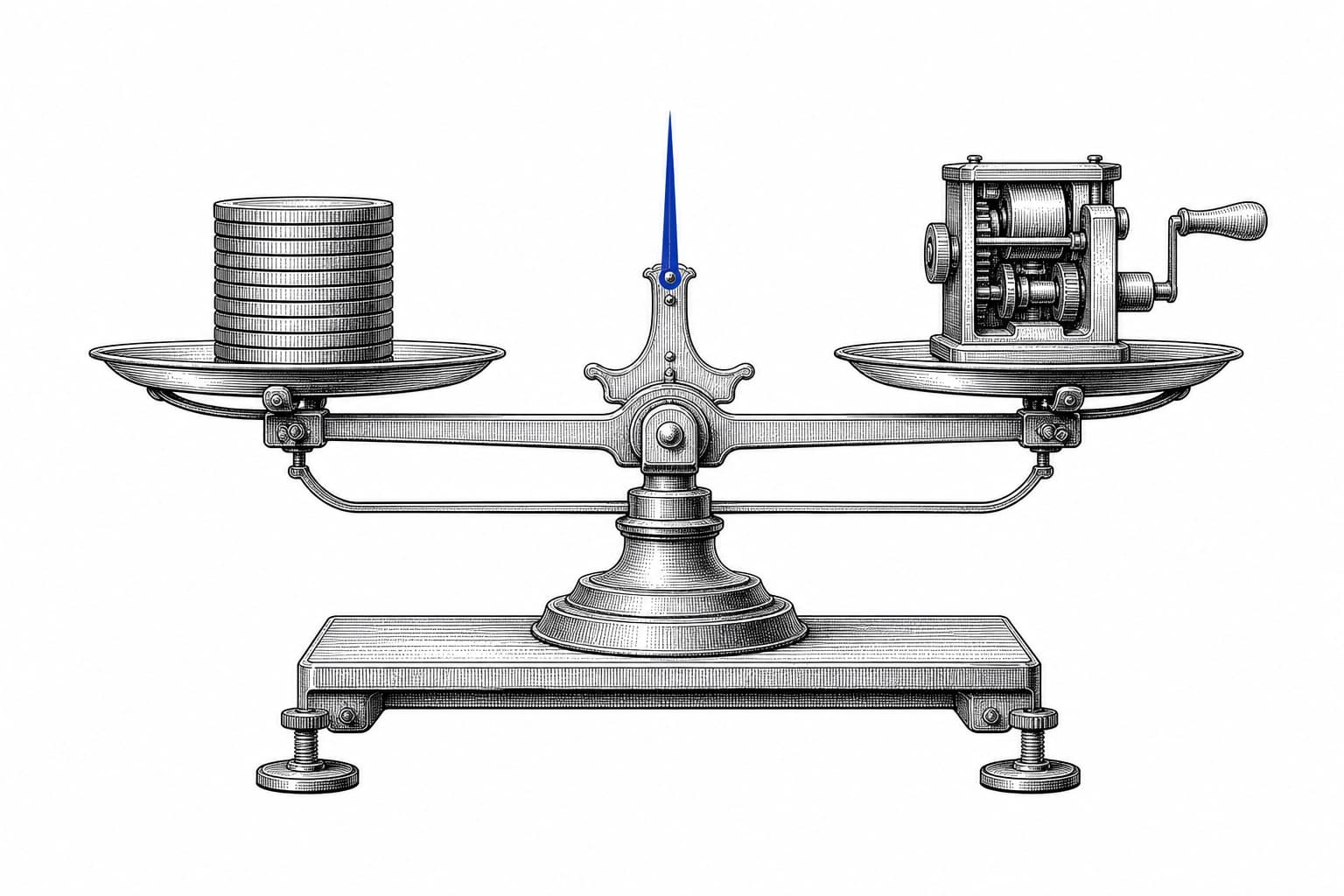
For two decades, nobody had to justify buying software. 'Build' was the deviation — the option that needed a business case, an executive sponsor, and someone willing to wear the blame. 'Buy' was the answer nobody got fired for, so renewals were processed rather than decided, and the question underneath them — is renting this still better than owning it? — went unasked for so long that most organizations no longer have anyone whose job is to ask it.
Three kinds of evidence say the default is dissolving, and they deserve different weights. The hardest is the repricing: in early February 2026, roughly $285 billion left software stocks in two days — the drawdown the financial press named the SaaSpocalypse [1]. That was not doom; it was arithmetic. Investors concluded that AI changes both what per-seat software can charge and what building a replacement costs, and marked the sector accordingly. It is the one event in this argument that has already fully happened.
The second kind is announcement. Starbucks has said it is building AI-assisted replacements for its Microsoft Dynamics inventory system and IBM Maximo maintenance system, against roughly $400 million a year of software spend, targeting 2027 [2]. We quote it as exactly that — a stated plan, not an outcome. Stated plans from operators of that size still carry information: a Fortune-100 company has run the build-vs-buy arithmetic on vendor systems of record and concluded, publicly, that build can win.
The third kind is self-report. In Retool's 2026 'Build vs. Buy' survey, 35% of enterprises said they had already replaced at least one SaaS tool with a custom build, and 78% of respondents planned more replacements in 2026 [3]. Surveys measure what people say, not what they did — quote them as such. But even discounted, the direction is consistent with the harder evidence.
Klarna is the cautionary tale, and it argues for discipline rather than against it. In 2024 the company announced it was shutting down Salesforce and Workday in favor of internally built, AI-era systems — the story that launched a thousand keynotes. The verified record is messier: reporting later established that Klarna had partly moved to alternative SaaS rather than pure internal builds, and the CEO himself pushed back on the mythologized version [4]. The moral is not 'the inversion is fake.' It is that a loud exit is not an achieved one — the gap between announcement and verified outcome is precisely why the decision needs measured adjudication instead of headlines.
Which is the actual point. The inversion does not mean build everything; systems of record carry real lock-in, and for many tools the verdict is keep, or renegotiate the renewal you were about to sign on autopilot. What the inversion means is narrower and more demanding: buying is no longer the default — it is a decision again, reopened silently at every renewal date on your calendar. Organizations know how to buy software. Very few have an apparatus for deciding whether to keep buying it: tool by tool, from their own numbers, with 'keep' as a legitimate answer rather than a lost sale.
That apparatus is what we sell, and its integrity mechanism is structural rather than rhetorical: the Exit Audit's fee is never credited toward a build, so the audit is paid to judge, not to sell the build that follows. Some audits end with 'stay, and here is the renewal to fight.' That outcome costs the same and we count it as a success — because the alternative, advice that always lands on 'replace', is not advice. It is a funnel wearing a tie.
- 1.Bloomberg, “What's Behind the 'SaaSpocalypse' Plunge in Software Stocks”; Forbes coverage of the same drawdown · 2026-02-04 / 2026-02-06
- 2.Bloomberg via press coverage: Starbucks' stated plan to build AI-assisted replacements for Microsoft Dynamics inventory and IBM Maximo maintenance — an announcement, not yet an outcome · July 2026
- 3.Retool, “Build vs. Buy 2026” — survey self-report: 35% had replaced ≥1 SaaS tool; 78% planned more in 2026 · 2026
- 4.CX Today, “Klarna Didn't Replace Salesforce with AI; It Replaced Them with Alternative SaaS Apps”; Salesforce Ben and Inc. coverage of the announcement and the walk-back · checked 2026-07-19